
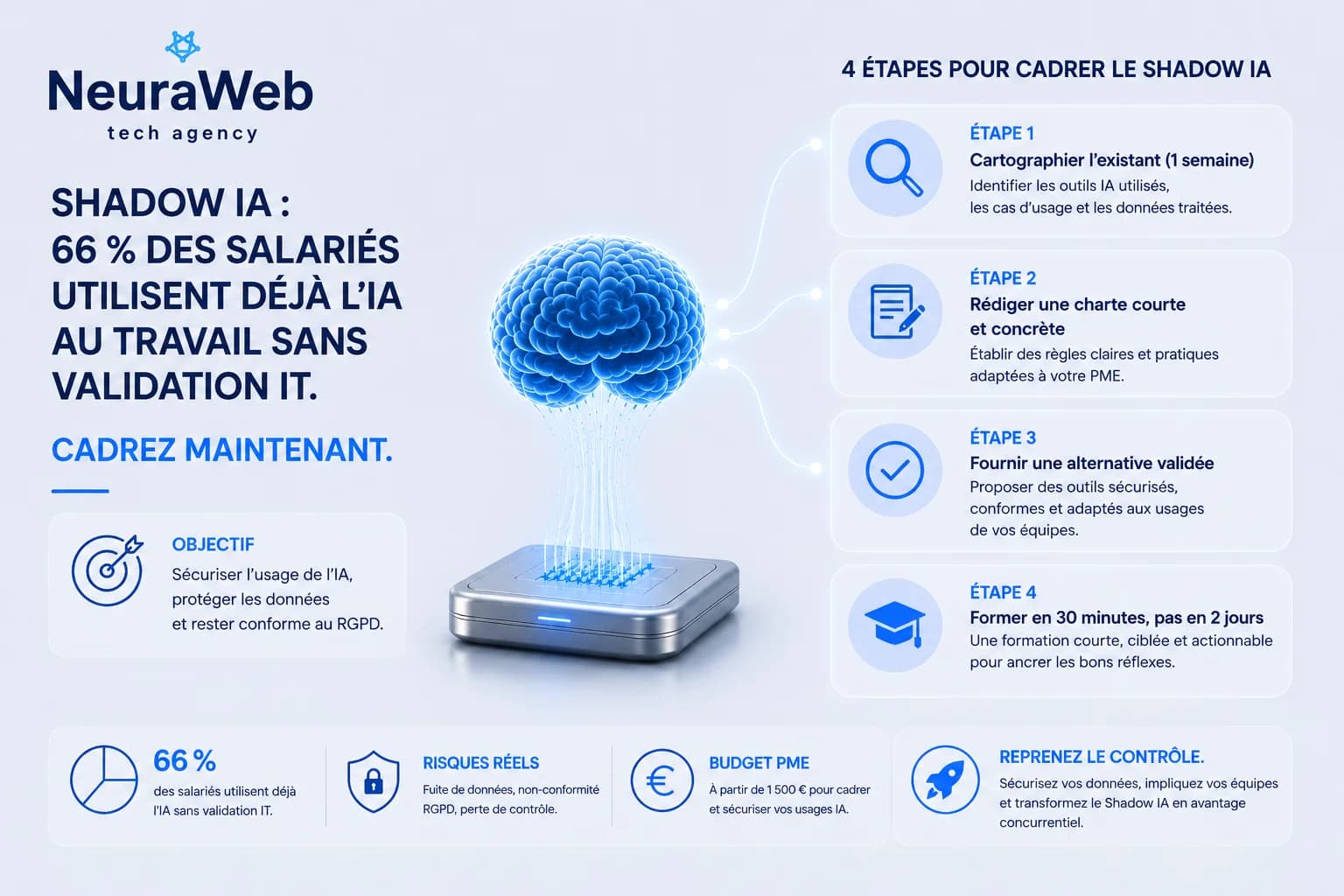
More than half of employees already use ChatGPT, Claude or Gemini at work — without their management or IT department signing off. This is Shadow AI: the informal use of AI tools completely outside any official framework.
The short answer: this isn't a minor detail. A 2026 PagerDuty report found that 66% of office professionals have already used an unauthorized AI tool at work, and a Cyberhaven analysis covering 1.6 million employees found that 11% of the data pasted into ChatGPT is confidential — source code, customer data, regulated information. For a French or European SMB, that means customer data leaks, GDPR non-compliance, and decisions made on unverified AI-generated answers. And most business owners don't even know it's already happening in their teams.
À retenir — Key Takeaways
- Scale of the phenomenon: 66% of employees already use AI at work without IT approval (PagerDuty, 2026)
- Concrete data risk: 11% of the data pasted into ChatGPT is confidential — source code, customer data, regulated information (Cyberhaven, across 1.6M employees analyzed)
- Compliance cost: between €0 (policy drafted in-house) and €800 (full external support) for an SMB of 10 to 50 employees
- Implementation time: 2 to 3 weeks for an operational policy and an awareness session
- Method: usage mapping, one-page policy, a validated alternative, 30-minute training
- Real case: a 22-employee SMB leaked customer contact details and quote amounts into a public AI tool for 6 months before internal detection
- Not needed for: a very small business with no sensitive customer or HR data can settle for a lightweight policy, without an external audit
Why is Shadow AI exploding in SMBs in 2026?
Three concrete reasons explain the scale of the phenomenon:
1. The tools are free and accessible in 30 seconds — no IT budget needed to open ChatGPT in a browser tab.
2. Employees just want to save time — drafting an email, summarizing a contract, preparing a customer reply. It's not malicious, it's ungoverned productivity.
3. Most SMBs have no policy, no validated tool, no training — so everyone makes up their own rules, or rather has none at all.
The figures published in 2024-2026 converge on the scale of the phenomenon:
| Study | Figure | What it measures |
|---|---|---|
| PagerDuty, 2026 | 66% | Office professionals who have used an unauthorized AI tool at work |
| Software AG, October 2024 | ~50% | Employees who use Shadow AI, most of whom wouldn't stop even if it were banned |
| Cyberhaven, 2024 | 11% | Share of data pasted into ChatGPT judged confidential (code, customers, regulated data) |
The result on the ground: customer data copy-pasted into public AI tools, contracts analyzed by tools whose data storage location is unknown, sales replies generated without review.
What is the real GDPR risk for an SMB?
GDPR makes no exception for AI. The moment an employee pastes a customer email, a phone number, a contract excerpt, or health data into a public AI tool:
The CNIL (France's data protection authority) has published its AI and GDPR recommendations to support responsible innovation, and is preparing targeted recommendations for the workplace sector for 2025-2026. The framework is clear: if an AI use in a company influences decisions about individuals or processes sensitive data at scale, a data protection impact assessment (DPIA) is required. In the event of a regulatory audit or a customer dispute, "I didn't know my teams were doing that" is not a valid defense — GDPR allows for sanctions of up to 4% of global annual turnover, even though sanctions actually issued against European SMBs remain, in practice, far below that ceiling.
Real case: a client SMB (B2B services, 22 employees) discovered that its sales team was systematically pasting incoming customer emails into a public AI tool to draft replies — including customer contact details and quote amounts. No policy, no validated tool, six months of practice before it surfaced during a routine internal audit.
How to govern Shadow AI in 4 steps without slowing anyone down
The goal isn't to ban AI — it's to channel a use that already exists, and make it safe.
Step 1 — Map current usage (1 week)
Before writing a single rule, simply ask your teams which AI tools they already use, and for what. An anonymous 5-question form is enough: which tools, how often, for what tasks, with what kind of data, and since when. You'll be surprised by the real scale — most business owners discover usage that's far wider and far older than they imagined.
Step 2 — Write a short, concrete policy
A useful policy fits on one page — not a 20-page legal document nobody will read. It should answer 3 simple questions for every employee:
Step 3 — Provide a validated alternative
Banning without offering an alternative never works. If your teams use AI to save time, give them a tool validated by your IT department or provider — an AI agent connected to your CRM under a clear data processing agreement, for instance, rather than a public ChatGPT account with no guarantees. This is the most effective lever: organizations that roll out a validated alternative see a sharp drop in unauthorized use, simply because the underlying productivity need finally has a legitimate answer.
Step 4 — Train in 30 minutes, not 2 days
A short session is enough: what's allowed, what isn't, and why. Understanding the risk (not fear) is what durably changes behavior. Plan a refresher at 3 months — good practices erode fast without a reminder.
Realistic budget for a 10-to-50-employee SMB: between €0 (policy drafted in-house) and €800 (external support + policy template + training session).
Public AI vs validated enterprise AI: the comparison
| Criteria | Public AI (free ChatGPT, Gemini) | Validated enterprise AI |
|---|---|---|
| Data processing agreement (DPA) | Absent or generic | Negotiated and documented |
| Model training on your data | Often yes (free tier) | No, contractually excluded |
| Usage traceability | None | Logged, auditable |
| Hosting | Variable, often outside the EU | Chosen (EU or standard clauses) |
| Cost | Apparently free | €80 to €300/month depending on usage |
| GDPR risk | High and undocumented | Managed and documentable |
The apparently zero cost of public AI is misleading: it's a risk transfer, not a saving. The bill simply moves downstream — to the day a customer asks what happened to their data, or a regulator asks the same question in a less friendly tone.
Checklist: does your SMB already have a Shadow AI problem?
Five questions to ask yourself without waiting for an external audit:
1. Have you already asked your teams which AI tools they actually use day to day?
2. Is there a written list of AI tools approved within your company?
3. Do your employees know which data must never be pasted into a public AI tool?
4. Do you have a clear point of contact for questions about AI usage?
5. Does your contract with your current AI tools include a data processing clause (DPA)?
If you answered no to three questions or more, Shadow AI is already active in your organization — the only question is how long, and with what data.
What to remember
Shadow AI isn't a future problem — it already exists in most SMBs, quietly, well before anyone puts a name on it. The question isn't "are my employees using AI without a framework," it's "for how long, and with what data."
A short policy, a validated alternative, and 30 minutes of training are enough to turn a hidden risk into governed use — without slowing anyone down.
---
Further reading
🔍 Want to know where your company really stands? NeuraWeb helps SMBs map their AI usage and put in place usage policies and secure alternatives. Request a free audit →
Let’s discuss your project
30-min discovery call: ask your questions, we sketch a concrete first plan with rough numbers.
30 min · no commitment
Book a meetingWeb, AI & automation
Discover our full range of tailor-made services for SMBs and freelancers.
See our services