
Published June 17, 2026 — data and solutions updated for the 2026 season.
Your phone rings during the Friday night rush — a customer wants to book for Saturday, but no one can pick up. Your hotel front desk is closed at 11pm when a British traveler asks about weekend availability. A third of your Saturday tables never show up, without notice. And your team spends 40% of its time answering the same ten questions.
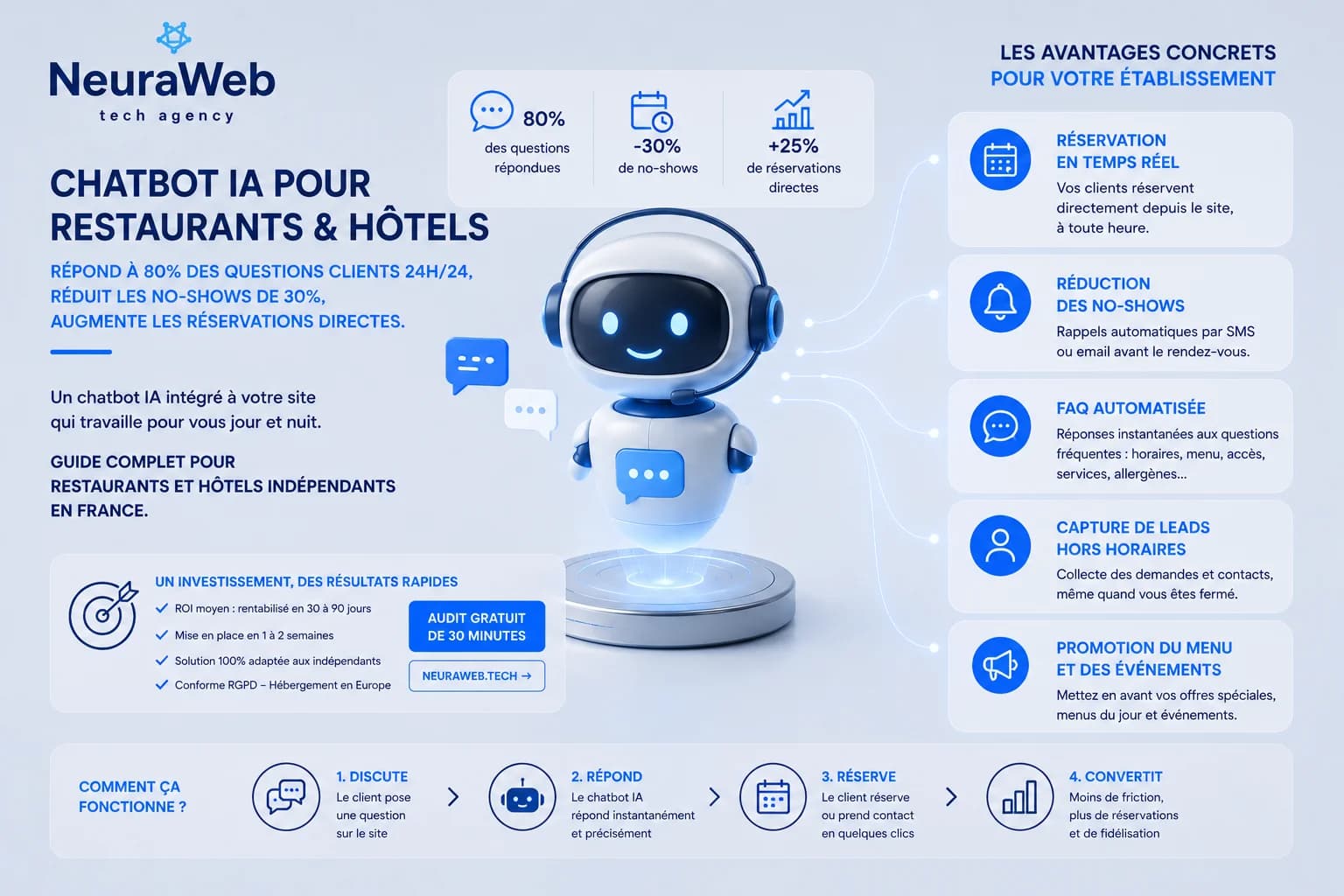
These four problems have the same solution: a well-configured AI chatbot, available 24/7, that answers, books, and follows up — while you cook, welcome guests, or sleep.
À retenir — Key Takeaways
- Availability: 60% of booking requests arrive outside opening hours — a chatbot captures all of them, without exception
- No-show reduction: automated follow-ups (SMS/WhatsApp 24h + 2h before) reduce no-shows by 25 to 30%, up to 70% in the most documented cases
- Automation: 80% of customer questions (hours, menu, availability, pricing, parking) require zero human intervention
- Hotel ROI: a 40-room hotel can generate +35% direct bookings and save up to €75,000/year in customer service costs (source: Voiceflow, 2026)
- Restaurant ROI: 4 additional bookings/week + 25% fewer no-shows = positive ROI from the first month for a 50-seat restaurant
- Multilingualism: an AI chatbot responds in French, English, Spanish and 40+ languages — a decisive asset for properties welcoming foreign guests
- GEO: chatbot conversations feed your visibility strategy in LLMs (ChatGPT, Perplexity, Google AI)
Why restaurants and hotels are adopting AI chatbots in 2026
The hospitality and restaurant sector faces a combination of pressures: rising labor costs, recruitment difficulties, customers increasingly demanding instant responsiveness, and competition from platforms offering a smooth 24/7 experience.
In 2026, 73% of customers check a website or Google before booking a restaurant or hotel. 45% of calls received concern information already available online (hours, menu, pricing, parking, pets allowed). These calls tie up qualified staff for zero-added-value tasks.
On the volume side, the numbers speak for themselves:
The AI chatbot is no longer a gadget for large hotel chains. It's an operational tool deployed at scale by independent restaurants, boutique hotels and mid-sized properties — on their website, WhatsApp, and directly within their booking systems.
What an AI chatbot can do for your restaurant
Take the concrete example of a 50-seat restaurant in Lille, lunch and dinner service, closed Sundays and Mondays. The owner picks up the phone between services — when they can. Result: missed bookings, unanticipated no-shows, repetitive questions that monopolize attention.
With an AI chatbot integrated into the site:
Real-time booking
The chatbot offers available time slots, collects party size, preferences (allergies, high chair, special occasion), and confirms by email or SMS — in under 2 minutes, at 11pm on a Sunday.
No-show reduction
Automatic reminder 24 hours before by SMS or WhatsApp, second reminder 2 hours before with a one-click modification or cancellation link. Restaurants deploying this workflow see -25% to -30% fewer no-shows within the first two months. Some documented cases reach -70% after 3 months of deployment.
Automated FAQ
"Do you have a vegetarian menu?", "Is there parking nearby?", "Do you accept dogs?", "Can I book for 15 people?". These questions represent 80% of incoming contacts — the chatbot answers them instantly, with your content, in your tone.
Lead capture outside hours
60% of requests arrive in the evening and on weekends. A restaurant without a chatbot loses a significant fraction of these requests in silence. An equipped restaurant captures 30 to 40% more bookings during these windows.
Menu and event promotion
The chatbot can highlight the menu of the day, themed evenings, lunch deals or group menus — at every interaction, with no extra effort from your team.
What an AI chatbot can do for your hotel
For an independent 40-room hotel in Hauts-de-France, the front desk can't be staffed around the clock. At night, on weekends, on holidays: requests fall into the void or end up on Booking.com, where a 15 to 17% commission awaits.
A hospitality AI chatbot changes the equation on several fronts:
24/7 direct booking
Connected to your PMS (Mews, Protel, Planyo, Resa Online) or a simplified availability calendar, the chatbot checks availability in real time, offers rates, accepts bookings and issues a confirmation — without going through an OTA, so without commission.
Virtual concierge
Questions about check-in/check-out, included services, breakfast, parking, local activities, nearby restaurants, transportation — the chatbot handles all of this instantly. The front desk can focus on physical welcome and complex requests.
Automated upselling
Offering an upgraded room at -15% vs. the standard rate, in-room breakfast, a bottle of champagne for an anniversary — the chatbot identifies opportunities and presents offers at the right time, before arrival.
Built-in multilingualism
For a hotel welcoming Belgian, British, Dutch or Spanish guests, the chatbot automatically responds in the detected language. No need for multilingual staff for basic information requests.
Post-stay loyalty
Automatic sending of a Google or Tripadvisor review request after check-out, a loyalty rate offer for the next stay, newsletter opt-in — the chatbot maintains the customer relationship long after departure.
Concrete ROI: what hoteliers and restaurateurs gain
The figures below come from 2025-2026 sector data (Voiceflow, Vynta.ai, hospitality and restaurant market studies):
50-seat restaurant — average ticket €35
| Lever | Estimated impact | Estimated annual gain |
|---|---|---|
| +4 bookings/week outside hours | +208 covers/year | +€7,280 revenue |
| -25% no-shows (2 tables/week recovered) | +104 covers/year | +€3,640 revenue |
| Staff time freed (calls/FAQ) | ~3h/week | Value: ~€4,500 |
| Total estimated gross gain | ~€15,420/year | |
| SaaS chatbot cost (€150/month) | -€1,800/year | |
| Estimated net ROI | ~€13,620/year |
Independent 40-room hotel — average rate €120/night
| Lever | Estimated impact | Estimated annual gain |
|---|---|---|
| +20% direct bookings (vs OTA) | Commission savings | +€36,000 |
| Reduced front desk calls (-50%) | 0.5 FTE freed | ~€15,000 |
| Automated upselling (+€8 per stay) | On 30% of bookings | +€10,000 |
| Total estimated gross gain | ~€61,000/year | |
| Custom chatbot cost (amortized over 3 years) | -€2,500/year | |
| Estimated net ROI | ~€58,500/year |
For a 150-room property, Voiceflow data documents +€180,000 in additional revenue and €75,000 in customer service savings — a 340% ROI in the first year with a payback period of 2 to 3 months.
Comparing AI chatbot solutions for hospitality and restaurants
The market offers solutions ranging from general-purpose SaaS tools to specialized hospitality platforms. Here's a comparison of the main options available in 2026:
| Solution | Specialization | Indicative price | Strengths | Limitations |
|---|---|---|---|---|
| Asksuite | Hospitality (global leader) | Quote-based (~€200-600/month) | Conversational AI, PMS integration, multilingual, documented 23x ROI | High price for small hotels |
| Quicktext (Quinta) | Luxury and boutique hotels | Quote-based | Hospitality-trained AI, conversion focus, FR support | Positioned high-end |
| TheFork Manager | Restaurants | Included in TheFork subscription | Integrated booking, automatic reminders | Tied to the TheFork ecosystem |
| Zenchef | French restaurants | From ~€80/month | French solution, GDPR-compliant, good UX | Less pure chatbot flexibility |
| Tidio / Crisp | General-purpose SMB | €25 to €150/month | Easy to deploy, web widget | Less hospitality-specialized |
| ChatBot (text.com) | General-purpose | €52 to €424/month | Visual builder, WhatsApp, integrations | Requires configuration |
| NeuraWeb custom chatbot | French SMB hotel/restaurant | Included in Business/Premium packs | Integrated into the site, GLM-4.5, FR/EN/ES, personalized | Available only with a NeuraWeb site |
Our recommendation for a French SMB: if you don't yet have a high-performing site, the most cost-effective approach is to integrate the chatbot directly during the site (re)creation — as NeuraWeb offers in its Business and Premium packs. You avoid double integration and benefit from a chatbot calibrated to your content from launch.
How to integrate an AI chatbot into your website (without breaking the budget)
Integrating an AI chatbot into an existing or new site follows a 5-step process:
1. Define priority use cases
Don't try to do everything at once. Start with the 3-5 most frequent questions and the booking flow. For a restaurant, that's: table booking + reminders + menu/hours FAQ. For a hotel: availability + stay FAQ + direct booking.
2. Connect your existing tools
The chatbot must be linked to your booking system (TheFork, Zenchef, Google Reserve, Planyo, Mews...) to access real availability. Without this connection, it can only collect requests — not process them.
3. Feed the knowledge base
Provide the chatbot with your content: menu, hours, pricing, cancellation policies, FAQ, practical information. The more complete the base, the less the customer escalates to a human.
4. Configure escalations
Define when the chatbot hands off to a human (complex requests, complaints, groups of 15+). A good chatbot knows what it doesn't know — and says so.
5. Test, measure, refine
The first 30 days reveal unanticipated questions. Continuously enrich the knowledge base. Frequent uncovered questions are content opportunities (blog, FAQ page) not to be missed.
Deployment time: 1 to 3 days for a standard SaaS solution, 2 to 3 weeks for a custom chatbot connected to your systems. No site redesign required.
AI chatbot and SEO / GEO: how to be found by LLMs
In 2026, AI engines (ChatGPT, Perplexity, Google AI Overviews, Claude) handle 12 to 18% of informational queries in English — this figure is rapidly rising in French. When a traveler asks ChatGPT "best boutique hotel in Lille with multilingual service", you want to be cited.
Your AI chatbot contributes to this visibility in two ways:
Indirectly — engagement signals
An active chatbot increases time spent on your site, reduces bounce rate, multiplies interactions. These engagement signals are exactly what AI engines consider when evaluating a domain's authority.
Directly — a GEO content mine
Every chatbot conversation reveals your customers' real questions. These verbatims are exactly the queries the same users type into ChatGPT or Perplexity. Turn them into:
GEO best practices for hospitality and restaurant businesses:
Restaurant or LodgingBusiness schema.org structured data to your siteWhat we offer at NeuraWeb
NeuraWeb is a web agency based in Lille, specialized in high-performing sites and AI integration for French SMBs — including independent restaurants and hotels in the Hauts-de-France region.
Our AI chatbot runs on the GLM-4.5 Flash model, available 24/7 in French, English and Spanish, and integrates directly into your Next.js site. It handles:
Our packs for restaurants and hotels:
| Pack | Price | AI Chatbot | High-performing site | SEO |
|---|---|---|---|---|
| Starter | €1,490 | Add-on module | ✅ | Basic |
| Business | €3,990 | ✅ Included | ✅ | Advanced |
| Premium | €7,990 | ✅ Included + advanced customization | ✅ | Complete + content |
Each project includes an analysis of your specific use cases, knowledge base configuration, and 30 days of post-launch follow-up.
We already work with restaurant and hospitality businesses in the Lille region. If you want to understand what an AI chatbot could specifically bring to your business, a 30-minute consultation is enough to quantify the potential.
Further reading
These NeuraWeb articles will help complete your digital strategy:
---
🤖 Ready to integrate an AI chatbot on your site? NeuraWeb deploys custom AI chatbots integrated into your website, available 24/7 in FR/EN/ES. See our AI offer → or Book an appointment →
Let’s discuss your project
30-min discovery call: ask your questions, we sketch a concrete first plan with rough numbers.
30 min · no commitment
Book a meetingRestaurant websites
Direct bookings, click & collect, loyalty: take back control of your commissions.
See the restaurant offer