
Your site is fast. Your content is solid. Your keywords are targeted. And yet, when a prospect types their question into ChatGPT or Perplexity, it's your competitor who answers in your place.
This isn't a quality problem. It's a method problem — and it's solvable for €120/month.
In 2026, SEO plays out on two fronts: traditional Google rankings, and answers generated by AI engines (Google AI Overviews, ChatGPT, Perplexity, Gemini). This second battle is called AEO — Answer Engine Optimization. This article explains how to automate both, with concrete tools, real field data, and a stack deployable in one week.
À retenir — Key Takeaways
- AI Overviews: active on 30 to 40% of commercial queries in France in early 2026; 60% of searches = zero click
- Click impact: positions 1–3 lose up to 40% of their clicks when an AI Overview appears above them
- AEO opportunity: only 38% of AI citations come from the top 10 — content structure trumps rank
- SEO+AEO stack: €120/month (n8n €20–50 + monitoring and analysis tools) — deployable in one week
- Topical authority: 8–12 interconnected articles on your specific niche outperform a 500-page generalist domain
- Winning format: answer the main question in the first 40–60 words, FAQ/HowTo schemas, data under 12 months old
Why your 2025 SEO no longer works in 2026
The AI Overviews disruption
Since early 2026, Google has been deploying AI Overviews on 30 to 40% of commercial queries in France. The concrete result: users get a synthetic answer directly in the SERP without having to click.
The measured consequences are real:
That last point is the most counterintuitive — and the most exploitable.
The AI citation paradox
Here's what most SEO guides still aren't saying: only 38% of citations in Google AI Overviews come from pages already in the top 10. AI engines select their sources based on different criteria: clarity of the answer, presence of original data, density of semantic entities, and thematic coherence of the domain.
Practical translation: a French SMB with a blog of 15 well-structured articles can appear in an AI Overview before a large generalist agency with 500 pages of diluted content.
This is the 2026 window of opportunity. It won't last.
AEO: being cited by AIs, not just ranked
Answer Engine Optimization consists of structuring your content so that AI engines choose it as a reference source in their generated answers.
Three criteria determine whether your content is citable:
1. The direct answer at the top of the article
AI engines extract the first sentences of an article to build their answers. If your introduction develops context before answering, you lose the citation to a competitor who answers in three clear lines.
Winning format: answer the main question within the first 40 to 60 words, before any development.
2. Schema.org structured data
FAQ, HowTo, Article and LocalBusiness schemas signal to AI crawlers (GPTBot, ClaudeBot, PerplexityBot, Google-Extended) that your content is organized and extractable. These bots now represent 33% of organic crawling activity — a third of robot traffic on your site is working for AI engines, not classic Google.
3. Thematic authority on your niche
An isolated page on a topic won't get cited, even if it's excellent. AIs prioritize domains that cover a subject in depth and consistently — what SEO calls topical authority. For an AI/automation agency, this means: a cluster of 8 to 12 interconnected articles on your specialty, with explicit internal links.
The €120/month stack to automate SEO + AEO
The three tools and their exact role
n8n — €20 to €50/month (orchestration)
n8n is the tool that runs your workflows automatically, without human intervention after setup. Initial configuration: 4 to 6 hours. After that: zero maintenance for standard use cases.
What n8n manages in our SEO stack:
Claude API — €30 to €60/month (analysis and generation)
Claude analyzes the content of your pages, identifies AEO gaps, generates Schema.org FAQs, writes meta-descriptions optimized for AI citations, and produces briefs for missing topics in your thematic cluster.
Where Claude excels vs GPT-4o on this use case: thematic consistency across recommendations. Claude maintains the context of your positioning across all articles in a cluster, producing semantically dense clusters — the key criterion for topical authority.
Google Search Console API — free
GSC is your only source of real data: rankings, impressions, CTR, non-indexed pages, crawl errors. Everything else (third-party tools) is an estimate. The n8n + Claude stack feeds on GSC data for recommendations based on your reality, not generic search volumes.
Total budget: €50 to €110/month. Adding an operational margin, the stack comfortably stays under €120/month.
At Neuraweb, we deployed this stack on several B2B SMBs between January and April 2026. If you want us to audit your current setup — positions, content structure, AEO gaps — the free 30-min audit is here.
The 5 automations to deploy first
Automation 1 — Automatic content audit
What it does: each time a new page is indexed, n8n sends the URL to Claude with the associated GSC data. Claude returns a structured audit: direct answer at the top of the article (yes/no), presence of Schema tags, semantic density, meta-description length, internal linking.
Time saved: 8 minutes per page vs 90 minutes for a manual audit. On a blog of 50 articles audited once per quarter: 70 hours recovered per year.
Automation 2 — Keyword cannibalization detection
What it does: n8n retrieves GSC data for all your pages every week and identifies semantic duplicates — two pages competing for the same queries. Claude analyzes the pairs and recommends which to merge, which to redirect, which to deepen.
Field result: on an e-commerce site with 120 pages, we detected 14 pairs of cannibal pages dragging each other's rankings down. After corrections: +18 average positions on the affected queries in 6 weeks.
Automation 3 — AEO-optimized FAQ generation
What it does: Claude analyzes the existing content of an article and generates 5 to 8 question/answer pairs optimized for AI Overviews — direct format, answer under 80 words, factual data included. Output: FAQ block in MDX ready to integrate + corresponding Schema.org schema.
Why this is critical: according to 2026 field data, articles with a well-structured FAQPage schema have a 2.4x higher probability of being cited in an AI Overview than the same articles without a schema.
Automation 4 — AI citation monitoring
What it does: n8n sends a list of your 20 priority queries to the Perplexity API and Google every week. For each query, it checks whether neuraweb.tech appears in the cited sources — and compares against your 3 main competitors.
What it reveals: the topics on which you have sufficient topical authority to be cited, and those where one additional article in your cluster would be enough to trigger the citation.
Automation 5 — Automatic weekly report
What it does: every Monday at 8am, a synthetic report arrives in Slack or by email. Content: positions gained/lost over the past 7 days, pages that moved from page 1 to page 2 (priority alert), new AI citations detected, suggested action for the week.
Real value: replaces 2 to 3 hours of weekly analysis work. And above all, it arrives even when SEO isn't the week's priority — which is the real reason SMBs lose their rankings.
Observed results: B2B SMB, January-April 2026
Here are the concrete figures from a project deployed in January 2026 for a French B2B SMB (digital transformation consulting firm, 12 employees, blog with 23 existing articles):
Weeks 1-2: audit of existing content, Schema corrections on 12 pages, generation of missing AEO FAQs, identification of the 3 critical cannibalization cases.
Weeks 3-4: first rankings improving on de-cannibalized queries. First article cited in a Perplexity AI Overview.
Weeks 6-8: organic traffic x2.8. 4 pages regularly cited in AI Overviews. 2 inbound leads per month directly attributable to the blog (vs 0 before).
Total budget deployed: €110/month for the stack + 6 hours of initial configuration.
This isn't an exceptional case. It's the logical consequence of a window of opportunity still open: most French SMBs haven't yet structured their content for AI engines.
How to get started without getting lost
Step 1 — GSC diagnostic (1h)
Before any automation, check the state of your current presence in Google Search Console:
This is your baseline. Without it, you're optimizing blind.
Step 2 — Identify your 20 priority queries (2h)
Not 200. Not 500. 20 queries on which you absolutely want to be cited in the next 90 days. Selection criteria: strong transactional or commercial intent, exploitable competition (not dominated by Wikipedia or major generalist publications), direct link to your services.
Step 3 — Deploy the stack in order
GSC API → n8n → Claude API → Slack alerts. Don't do everything in parallel. Test on 5 pages before rolling out broadly. n8n configuration takes 4 to 6 hours for a developer familiar with the tool — or 2 to 3 days for an ops profile discovering it.
Step 4 — Wait 30 days before adjusting
Automated SEO is not growth hacking. The first signals arrive in weeks 3-4. Consolidated results in weeks 6-8. Adjusting the stack before 30 days means changing strategy before you have data — the classic mistake that makes people believe "it doesn't work."
What Google actually rewards in 2026
The March 2026 Core Update clarified what Google means by "helpful content": content that demonstrates first-hand experience on the topic covered. Not content that talks about experience — content that proves experience through original data, real figures, verifiable technical details.
For an agency like Neuraweb, this translates to: measured results on your projects, detailed technical stack with real costs, errors encountered in production and how you solved them.
This is precisely the type of content that AI engines select as a source — because it's precisely the type of content their users find reliable.
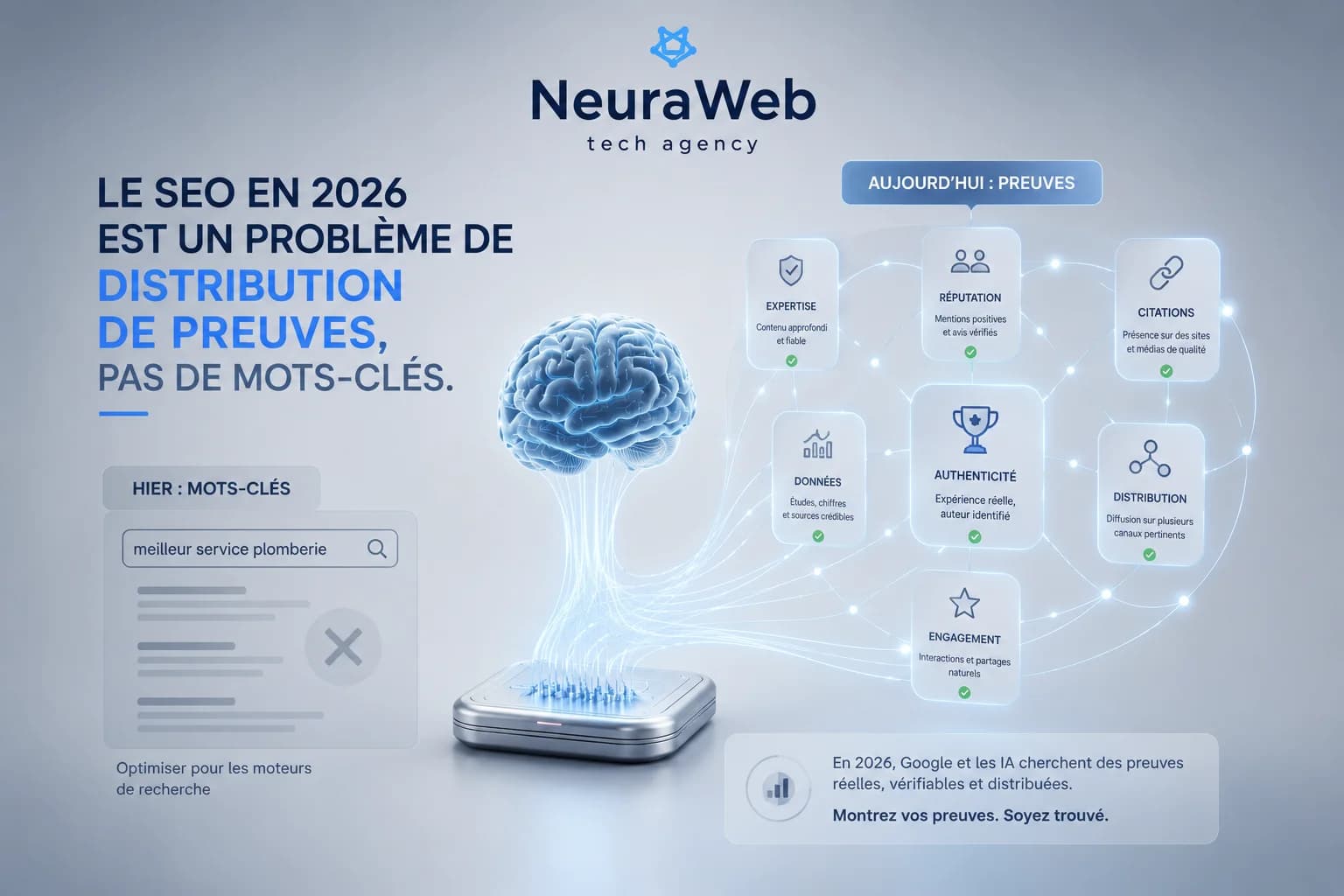
SEO in 2026 isn't a keyword problem. It's a proof distribution problem.
---
Further Reading
---
Free SEO + AEO audit — 30 minutes, no commitment
We analyze your current rankings, your content structure, and your AEO gaps. You leave with a prioritized action list, whether you work with us or not.
Let’s discuss your project
30-min discovery call: ask your questions, we sketch a concrete first plan with rough numbers.
30 min · no commitment
Book a meetingTailor-made websites
Next.js, Core Web Vitals performance, technical SEO. Packs from €1,490.
See the packs