
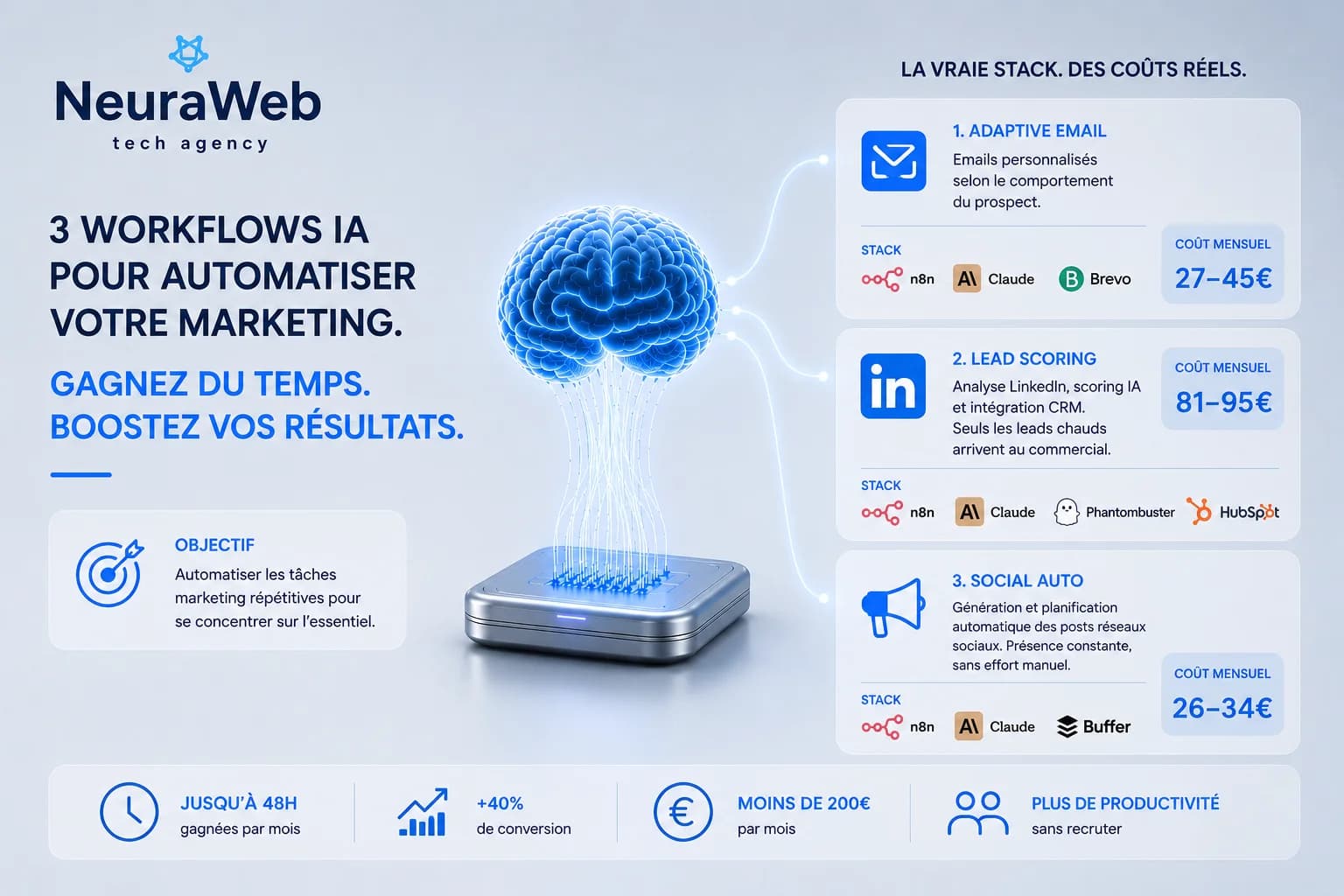
Running marketing for a small business means 8 to 15 hours of repetitive tasks every week. Emails to personalize, leads to qualify, posts to schedule — time-consuming work you're paying for in hours or freelancer fees.
In 2026, AI agents can automate 80% of that workload for under €300 per month. Not "ChatGPT writing your emails" — real automation, with named tools, concrete steps, and measurable results on your actual marketing KPIs.
Here are the 3 workflows Neuraweb deployed for French SMBs this year — full stack, real costs, and field data included.
À retenir — Key Takeaways
- Cost: €27–45/month for the adaptive email workflow (n8n + Claude API + Brevo); €81–95/month for lead scoring with LinkedIn enrichment
- Adaptive email results: +34% open rate, +18% click rate, 3h/week recovered for a B2B SMB processing 40–60 leads/month
- Lead scoring results: +42% conversion lead→meeting, 5h/week saved on phone qualification
- Stack: n8n (€20/month) + Claude API (€5–15/month) + Brevo (free) + Phantombuster (€56/month for scoring)
- Setup: 1–2 days per workflow, no technical skills needed with n8n
- ROI: measurable results from month one — payback in under 3 months across all 3 documented cases
Workflow 1: Adaptive Email — Personalization Without a Marketing Team
What it automates
Email personalization based on your prospects' actual behavior: page visited, form submitted, prolonged inactivity. No more generic sequences blasted to your entire list.
The technical stack
Total monthly cost: €27 to €45 depending on email volume.
How it works, step by step
1. A visitor fills out a form on your site → automatically triggers the n8n workflow
2. n8n retrieves context: industry, company size, page visited
3. This data is sent via API to Claude, which generates a personalized email in 2 seconds
4. Brevo sends the email within 60 seconds of the form submission
The key point: Claude doesn't write a fixed template. It adapts the tone, examples, and commercial angle based on each prospect's profile. A CTO at a SaaS startup doesn't receive the same email as an e-commerce store owner.
Measured results on a real client
Client: B2B services SMB, Île-de-France, 8 employees, 40 to 60 inbound leads per month.
Workflow 2: Automated Lead Scoring — Qualify Without Calling Cold
What it automates
Real-time evaluation of every new inbound lead, so your sales rep only calls genuinely warm prospects. Everyone else automatically enters an email nurture sequence.
The technical stack
Total monthly cost: €81 to €95 depending on lead volume.
How it works, step by step
1. A lead submits a form on your site
2. n8n triggers a Phantombuster search on the contact's LinkedIn profile
3. Enriched data arrives in n8n: company size, job title, recent LinkedIn activity
4. Claude analyzes the profile and generates a score out of 10 + a 3-line sales brief
5. If score ≥ 7: lead created in HubSpot with a "Call today" task assigned to the sales rep
6. If score < 7: the adaptive email workflow (see above) automatically takes over
Claude's scoring uses concrete business criteria: does the company have the right size for your offer? Does the contact's role involve budget authority? Is there recent activity signaling an active need?
Measured results on a real client
Client: B2B web agency, 12 employees, approximately 25 inbound leads per week.
Neuraweb helps French SMBs with the full configuration of this workflow — from HubSpot integration to the Claude prompt calibrated for your specific market. Request a free audit to assess what you can automate in 30 minutes.
Workflow 3: Social Auto — Social Media Presence Without a Community Manager
What it automates
Weekly generation and scheduling of your posts on X, LinkedIn, and Google Business. The goal isn't to replace your editorial strategy — it's to eliminate the production friction.
The technical stack
Total monthly cost: €26 to €34.
How it works, step by step
1. Every Monday at 7am, n8n automatically triggers the workflow
2. It sends Claude: the week's topics defined in advance, industry news via RSS feeds, and your editorial guidelines (tone, topics to avoid, preferred formats)
3. Claude generates 5 optimized posts for each active network — format, length, and hashtags adapted per platform
4. Buffer automatically schedules posts at the best time slots for your audience
5. Review in 15 minutes — or direct publishing if you trust the calibration
Measured results on a real client
Client: B2C retail SMB, fashion e-commerce, 4 employees.
What You Actually Get Back
| Workflow | Time saved | Monthly cost | Measurable result |
|---|---|---|---|
| Adaptive email | 3 h/week | €27–45 | +34% open rate |
| Lead scoring | 5 h/week | €81–95 | +42% lead → meeting conversion |
| Social auto | 4 h/week | €26–34 | Presence maintained, ×4 frequency |
| Total | 12 h/week | €134–174 | ~48 hours/month freed |
48 hours per month for under €175 — the equivalent of 6 weeks of work per year recovered from low-value, repetitive tasks.
Where to Start Based on Your Situation
Low inbound lead volume: start with social auto. Increasing your presence builds visibility first, which feeds the other two workflows.
Leads coming in but low conversion rate: lead scoring is your priority. It qualifies in real time without tying up your sales rep.
Email open rate below 20%: adaptive email will deliver visible results within two weeks of deployment.
Most SMBs we work with at Neuraweb start with the email workflow: under 48 hours to configure, measurable results by the second week.
Common Pitfalls When Deploying These Workflows
Based on the SMBs we've supported, three mistakes consistently blunt the ROI of these workflows.
Skipping data cleanup before switching on personalization. Adaptive email and lead scoring both depend on the quality of your existing CRM and lead data. If your contact list has outdated fields, missing industries, or duplicate entries, Claude's personalization degrades immediately — the AI can only work with what it's given. Budget half a day to clean your top 200 contacts before activating either workflow.
Writing one generic prompt and never revisiting it. The first Claude prompt rarely nails the ideal tone on the first attempt. SMBs that get the best results treat the prompt as a living document: they review 10 to 15 generated emails or posts during week one, adjust the instructions, and re-test. Skipping this iteration step is the single biggest reason a workflow underperforms its documented potential.
Automating before defining escalation rules. All three workflows work best with clear boundaries: which leads bypass scoring and go straight to a human, which client relationships are too sensitive for an automated tone shift, which social media topics need manual review before publishing. Teams that define these rules upfront avoid the awkward automated message that damages a relationship — and the workflow keeps its credibility internally.
A concrete example: from generic to calibrated in three iterations
One of our clients, a boutique consulting firm, launched the adaptive email workflow with a first prompt simply asking Claude to "write a friendly follow-up." Results were mediocre: open rates barely moved from the baseline. After reviewing 12 real emails together, we added explicit constraints to the prompt — no exclamation marks, always reference the specific page the prospect visited, keep the body under 80 words, close with a single clear question rather than a generic call-to-action. We reran the sequence on the next batch of leads.
The open rate jumped from a marginal +6% to the +34% now documented above, without touching the underlying stack or budget. The lesson generalizes to all three workflows: the tools matter less than the 2 to 3 hours spent calibrating the instructions given to the AI. Most SMBs underinvest in this step because it feels like "just writing," when it's actually the highest-leverage part of the entire setup.
---
Further Reading
Let’s discuss your project
30-min discovery call: ask your questions, we sketch a concrete first plan with rough numbers.
30 min · no commitment
Book a meetingAI automation & workflows
n8n, Make, AI agents: automate follow-ups, leads and processes. Setup in days.
Discover the service